Tesla Brings Its Robotaxi Service to Dallas and Houston
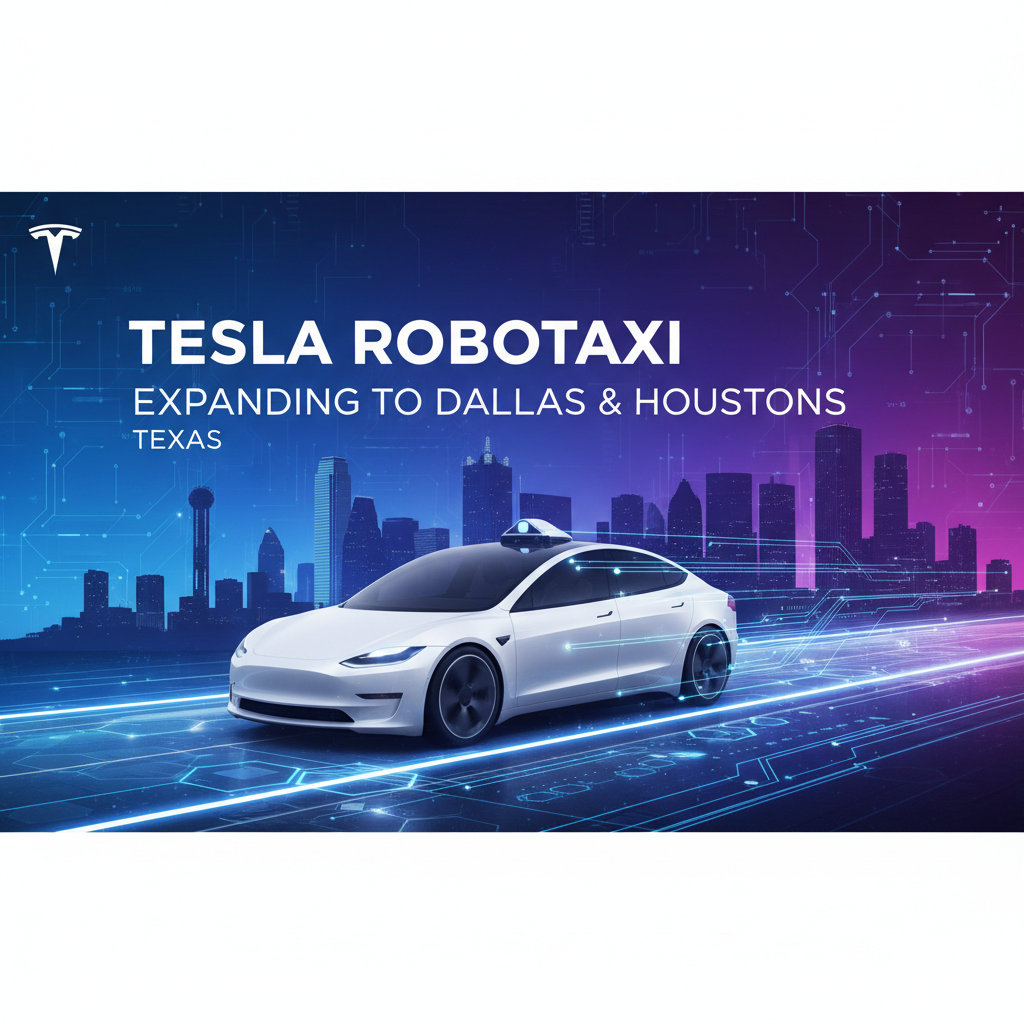
Tesla is expanding its robotaxi network beyond Austin, launching driverless ride-hail service in Dallas and Houston — two of Texas’s largest metro areas. The announcement came via a 14-second video posted on social media, showing Tesla vehicles cruising with empty front seats. No press release, no investor call. Just a short clip and a emoji. That is classic Tesla.
How Does Tesla’s Robotaxi Rollout Work?
Tesla confirmed the launch with a simple post: “Robotaxi is now rolling out in Dallas & Houston 🤠”. The service operates without safety drivers in the front seat, putting it in direct competition with established players in the autonomous vehicle space. Unlike some competitors that use a hybrid model with remote monitors or fallback drivers, Tesla’s system is designed to run fully driverless — a bet on the maturity of its neural network software.
The company started its robotaxi journey in Austin in 2025, then began offering rides without human monitors in January 2026. Now the network spans three Texas cities — Austin, Dallas, and Houston — signaling a deliberate push to prove the model works at scale. The expansion was not gradual. Tesla went from one city to three in a matter of months.
The Numbers Tell a Cautious Story
Early fleet data from Robotaxi Tracker reveals the current scale of operations:
| City | Active Vehicles (Logged) |
|---|---|
| Austin | 46 |
| Dallas | 1 |
| Houston | 1 |
One vehicle in each new city. That is the honest number, not a typo. Tesla may not be running a substantial fleet in Dallas and Houston yet. The company appears to be taking a staged approach — launching coverage first, then scaling operations based on demand and operational learning. A single vehicle can cover a neighborhood or a predefined route, demonstrating capability without the overhead of a full fleet deployment.
What About Safety?
Tesla’s Austin robotaxis have accumulated 14 crashes since the service launched, according to a February filing. That number covers the entire period from launch through early 2026. Context matters when evaluating this statistic. Tesla’s fleet in Austin has driven millions of miles during that period, and the crash rate per mile is what safety experts actually look for. Any crash involving a driverless vehicle attracts intense media scrutiny and regulatory attention, regardless of severity.
Tesla is not the only player operating in the Bay Area, but its approach differs fundamentally. Tesla relies solely on cameras and neural networks — a vision-only stack that it argues can match or exceed human driver safety. Competitors like Waymo use LIDAR as a primary sensor, combined with high-definition maps. Tesla’s approach has no backup LIDAR sensor; the cameras and the neural network have to do all the perception work in real time. This remains controversial in the autonomous vehicle industry. Many safety experts argue LIDAR provides reliability that cameras cannot yet match in adverse weather or lighting conditions.
Tesla’s Vision-Only Stack: Controversy and Cost Advantage
Tesla’s decision to skip LIDAR entirely was not accidental. LIDAR sensors add thousands of dollars to each vehicle’s cost. By eliminating them, Tesla can deploy robotaxi vehicles at a significantly lower hardware cost — potentially making the economics work at scale where competitors struggle. The argument is that humans drive with two eyes and a brain, and so can machines.
The counterargument is equally strong: LIDAR can measure distance directly and works in darkness, rain, and fog. Cameras estimate distance probabilistically, learning from patterns. At scale, Tesla’s approach may prove superior — or it may hit fundamental limits in edge cases that cause accidents. The Austin crash record so far suggests the system is not failing catastrophically, but the sample size remains too small to draw strong conclusions.
Tesla’s Autonomous Strategy: Enterprise Pivot or Consumer Moonshot?
This robotaxi expansion comes amid broader shifts at Tesla. The company has been trimming side projects and refocusing on core business lines. Under Elon Musk’s renewed focus, Tesla has been streamlining operations, cutting programs that do not contribute directly to near-term revenue. Robotaxi represents one of the more visible consumer-facing applications of Tesla’s AI technology — and the fact that it is moving beyond a single-city pilot suggests leadership believes the system is ready for wider deployment.
The company has also been dealing with external pressures. Recent departures of key AI research staff, shifting government relationships, and broader market volatility have created noise around Tesla’s strategic direction. Against that backdrop, robotaxi expansion is a concrete signal that the autonomous driving program remains a priority — not a science project, but an operational business.
Whether the service can scale profitably with a handful of vehicles per city is a separate question. Tesla’s historical approach to product launches — deploy early, gather real-world data, iterate rapidly — suggests more vehicles could follow quickly if the initial operations show promise.
The Texas Advantage
Tesla’s preference for Texas as a launchpad makes strategic sense. The state has relatively friendly regulations for autonomous vehicle testing, no state income tax, and large metro areas with substantial ride-hail demand. Texas Governor Greg Abbott has actively courted tech companies looking for a regulatory environment that allows faster experimentation without the permitting complexity seen in California.
Running robotaxis in Austin, Dallas, and Houston gives Tesla coverage across the three biggest Texas markets. Each city represents a different operational environment: Austin is college-town dense, Dallas is sprawling and car-centric, and Houston is massive with intense summer heat. Testing across all three gives Tesla diverse real-world data on how its vision-only system performs.
For now, the Bay Area continues to operate under a limited model with human drivers present — a reminder that even Tesla is taking a cautious approach in its home region’s more complex regulatory environment. California requires permits for autonomous vehicle testing and has stricter reporting requirements than Texas. Tesla has not yet launched fully driverless service in California.
The Competitive Landscape: Waymo, Cruise, and Others
Tesla is not entering an empty market. Waymo, backed by Alphabet, has been operating robotaxis in San Francisco and Phoenix for years. Cruise, owned by General Motors, had to rebuild after a 2023 incident in San Francisco that triggered a regulatory crackdown. Other players including Aurora and Zoox are also developing autonomous vehicle technology.
Each competitor brings a different approach:
| Company | Sensor Stack | Key Markets |
|---|---|---|
| Waymo | LIDAR + Camera + HD Maps | SF, Phoenix, Los Angeles |
| Cruise | LIDAR + Camera | San Francisco (rebuilding) |
| Tesla | Camera + Neural Network | Austin, Dallas, Houston |
| Aurora | LIDAR + Radar + Camera | Dallas, Houston (trucking) |
The table reveals the fundamental split: most competitors use sensor fusion with multiple redundant systems, while Tesla bets everything on vision and AI. The market will eventually determine which approach is safer and more scalable.
What This Means for the Industry
Tesla’s multi-city robotaxi expansion is a proof point that the company’s self-driving technology has moved from experimental to operational. With 14 crashes in Austin and only a handful of vehicles in the new markets, the company still has plenty to prove on safety and reliability.
But the trajectory is clear: Tesla is no longer testing robotaxi in a single city. It is building a network. The Dallas and Houston launches mark the first step toward what could eventually become a nationwide autonomous ride-hail competitor — directly challenging Waymo in the cities where it operates and potentially pressuring traditional ride-hail companies like Uber and Lyft.
For now, the autonomous vehicle industry is watching. If Tesla can demonstrate that its vision-only approach works safely across multiple cities and scales economically, it could force the entire industry to reconsider the LIDAR-dependent orthodoxy. If not, the door remains open for competitors with different technical approaches to dominate.
What Happens Next
The immediate next steps for Tesla are operational scaling. A single vehicle in Dallas and Houston is a demonstration; dozens or hundreds would be a business. How quickly Tesla adds vehicles will depend on regulatory approvals, operational learnings, and demand signals from early riders.
For Tesla shareholders, the robotaxi expansion is a concrete demonstration that the company’s AI investments are starting to generate tangible revenue streams beyond vehicle sales. For the broader public, it means more options for driverless rides in Texas — and more data on how well autonomous vehicles perform in real urban environments.
Sources: TechCrunch (April 18, 2026), Robotaxi Tracker, Tesla social media announcement, February safety filing.