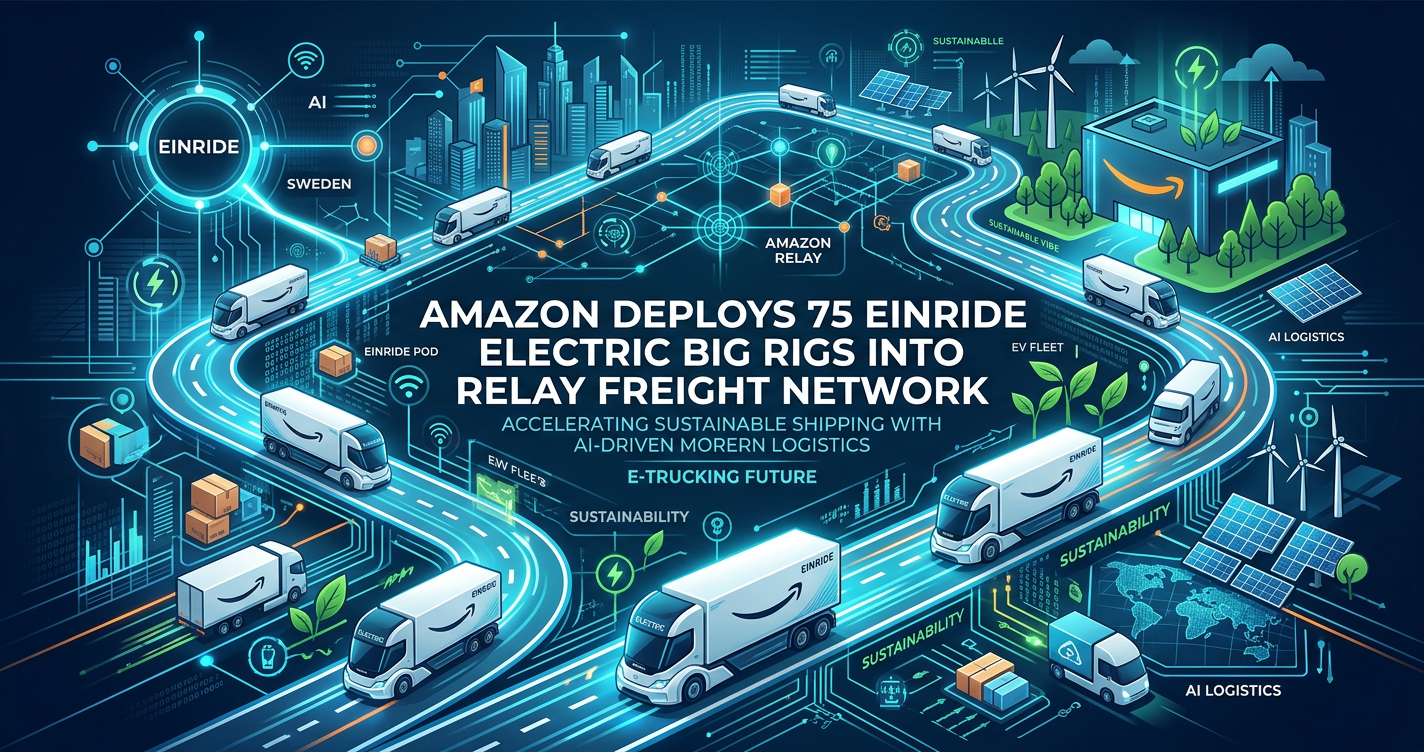
Amazon is putting 75 electric heavy-duty trucks from Swedish startup Einride into its Relay freight network — the e-commerce giant’s biggest U.S. deployment of battery-powered big rigs to date. The deal, announced Tuesday, gives Amazon a new partner in its push to electrify the middle mile of its logistics chain, while giving Einride a high-profile validation of its technology ahead of a planned public offering.
What Amazon Is Actually Doing Here
Amazon isn’t buying these trucks. It isn’t operating them either. Einride owns the vehicles, maintains them, and runs them through its own Saga AI optimization software. What Amazon gets is simple: access to 75 electric big rigs that can haul freight within its Relay network — the app-based platform launched in 2017 that lets truck drivers book hauling jobs with Amazon directly.
Think of Relay as the Uber app for middle-mile trucking. Drivers use it to pick up loads between Amazon’s fulfillment centers, sort facilities, air hubs, and last-mile delivery stations. The 75 Einride trucks will operate in that same loop, running routes Amazon previously powered with diesel.
These aren’t autonomous vehicles. The deal specifically covers manually operated electric trucks. But Einride does have autonomous approvals in five U.S. states — including Texas, secured just recently from the National Highway Traffic Safety Administration — and the company runs a daily commercial autonomous route for GE Appliances in Tennessee. The Amazon agreement doesn’t tap that capability, but it puts Einride’s EVs squarely inside one of the world’s most demanding logistics networks.
The Scale: 3 Million Electric Miles a Year
Amazon projects the Einride fleet will cover up to 3 million electric transport miles annually. That sounds abstract until you consider what 3 million miles means in practice — roughly 120 trips around the Earth’s circumference, every single year, with zero tailpipe emissions.
Einride will also build out charging infrastructure at five locations across the United States to keep the trucks running. The company’s Saga AI platform handles route optimization and charging planning for these loads — a key part of what makes Einride more than a truck leasing company.
Why This Matters for Amazon’s Climate Goals
Amazon has committed to net-zero carbon emissions across its operations by 2040. That’s an ambitious target, and the company has methodically layered different pieces of its logistics network into its decarbonization strategy:
- 2019: Amazon invested in Rivian and announced a deal for 100,000 electric delivery vehicles by 2030
- Early 2025: Amazon Europe ordered 200 heavy-duty EV trucks from Mercedes — its largest-ever European big rig order
- 2024: Amazon deployed 50 Volvo trucks for U.S. freight operations tied to Southern California ports — its then-largest domestic heavy-duty EV fleet
- Now: 75 Einride trucks, representing its biggest single U.S. freight EV deployment
The middle mile has been one of the harder pieces to crack. Delivery vans get attention because they run fixed urban routes and return to base nightly — easy charging logistics. Big rigs are different. They haul heavier loads across longer distances, require more energy per mile, and need charging infrastructure that doesn’t yet exist at most freight hubs. By partnering with Einride, which handles the trucks and the charging buildout, Amazon sidesteps both of those problems.
“This rollout is an important step forward in addressing one of the toughest challenges we face in decarbonizing our transportation network — electrifying heavy-duty trucking,” an Amazon spokesperson said in a statement.
What Einride Gets Out of This
For Einride, landing Amazon is the kind of customer reference that matters when you’re preparing to go public. The startup has announced plans to merge with blank-check company Legato Merger Corp. III during the first half of this year, a deal expected to raise over $300 million. Being able to point to Amazon as a client — even at this scale — changes the narrative heading into that IPO.
Einride has spent years building out its two-pronged freight business. On one side: a fleet of roughly 200 heavy-duty electric trucks operating for clients like Heineken, PepsiCo, and Carlsberg Sweden across Europe, North America, and the UAE. On the other: its autonomous pod-style trucks, notable for their cab-less design, which represent the company’s bet on driverless freight.
CEO Roozbeh Charli, who took the helm nearly a year ago, framed the Amazon deal as validation. “By deploying our intelligent platform within one of the world’s most sophisticated logistics networks, we are accelerating growth, while continuing to build industry-leading operational expertise,” he wrote on LinkedIn.
Amazon board member Keith B. Alexander — the former NSA Director General — joined Einride’s board earlier this month, a signal the company is also pursuing defense-sector business alongside its commercial expansion.
The Competitive Landscape
2026 is shaping up to be a pivotal year for autonomous EV trucking in the United States. Einride’s rivals are all scaling operations simultaneously:
- Waabi is pushing toward commercial autonomous deployments
- Aurora Innovation is expanding its driverless freight network
- Kodiak AI is actively growing its Texas operations
Einride currently holds autonomous operating approvals in Arizona, Colorado, South Carolina, Tennessee, and now Texas — giving it one of the broadest state-level footprints for autonomous freight in the country. But on the Amazon deal, the company is keeping things conventional: human drivers, electric motors, zero emissions.
The Bottom Line
This isn’t a transformative deal for Amazon — a $2.7 trillion company can absorb 75 trucks without blinking. But it demonstrates that electric big rig adoption is accelerating beyond pilot programs into real operational integration within major logistics networks. Einride handles the capital expenditure, the maintenance, and the charging infrastructure. Amazon gets clean miles and operational learning. Both sides get something they need heading into very different but equally high-stakes next chapters — an IPO for Einride, and the long march toward 2040 net-zero for Amazon.
Want to stay on top of how major tech companies are tackling climate and logistics? Subscribe to our weekly brief covering the intersection of AI, technology, and sustainability.